



Canada’s FIFA World Cup 2026 windfall is real, but it is not evenly distributed and it is not yet fully measurable. Toronto and Vancouver delivered packed stadiums, international attention and a surge of activity for selected hotels, restaurants, bars, retailers and transportation operators. Other businesses saw only modest gains, while public agencies carried substantial hosting, infrastructure and security costs.
Canada hosted 13 of the tournament’s 104 matches, with six in Toronto and seven in Vancouver. The Parliamentary Budget Officer estimated total government support across all levels at $1.066 billion, including $473 million federally and $593 million from other governments. Dividing that estimate by 13 produces the widely quoted figure of approximately $82 million per Canadian match. That is a rough public-support ratio, not proof that each match lost $82 million.
The $3.8-billion projection is economic output, not profit
A FIFA-commissioned assessment prepared by Deloitte Canada estimated that tournament preparation and hosting could generate up to $3.8 billion in Canadian economic output between June 2023 and August 2026. It also projected approximately $2 billion in GDP, $1.3 billion in labour income, $700 million in government revenue and the creation or preservation of 24,100 jobs.
Economic output measures activity moving through the economy. It is not a $3.8-billion profit after public costs. Stadium work, security contracts, temporary employment, hotel stays and restaurant purchases may all increase output, but the source of the spending and the costs required to generate it still matter.
For Canadian entrepreneurs, the central questions are more practical. How much new spending came from visitors who would not otherwise have been in Canada? Which sectors retained the revenue? How much local spending was merely redirected from one neighbourhood or business to another?
Toronto produced packed matches and uneven business gains
Toronto welcomed 258,088 spectators across six matches at Toronto Stadium. FIFA reported 43,036 spectators for the city’s final match, bringing average attendance to roughly 43,000 per game. Deloitte projected up to $940 million in economic output for the Greater Toronto Area, including $520 million in GDP, $340 million in labour income, $25 million in government revenue and more than 6,600 jobs created or preserved.
Early payment data show a benefit, but not a universal windfall. Moneris data covering June 12 to June 26 found that hotel spending increased 18 per cent compared with the same period in 2025. Restaurants and bars increased three per cent, big-box spending rose four per cent, grocery spending increased six per cent and apparel spending declined five per cent.
Foreign-issued cards showed a stronger visitor effect. International cardholders spent 34 per cent more at restaurants and bars, 19 per cent more at grocery stores and seven per cent more at hotels. This suggests that international visitors were active consumers, particularly in food and beverage businesses. It also explains why a tourism-focused operator may have performed very differently from a business relying mainly on local customers.
The Toronto results contain a warning for entrepreneurs. A global event can fill a stadium without lifting every nearby business equally. Match schedules, pedestrian traffic, reservations, operating hours, inventory and the ability to attract international customers influence who captures the spending. Destination Toronto also reported that nine out of 10 international visitors surveyed at Toronto Stadium and the Fan Festival intended to return within two years. That is encouraging, but stated intention is not a confirmed future booking.
Vancouver recorded stronger success stories, but the data differ
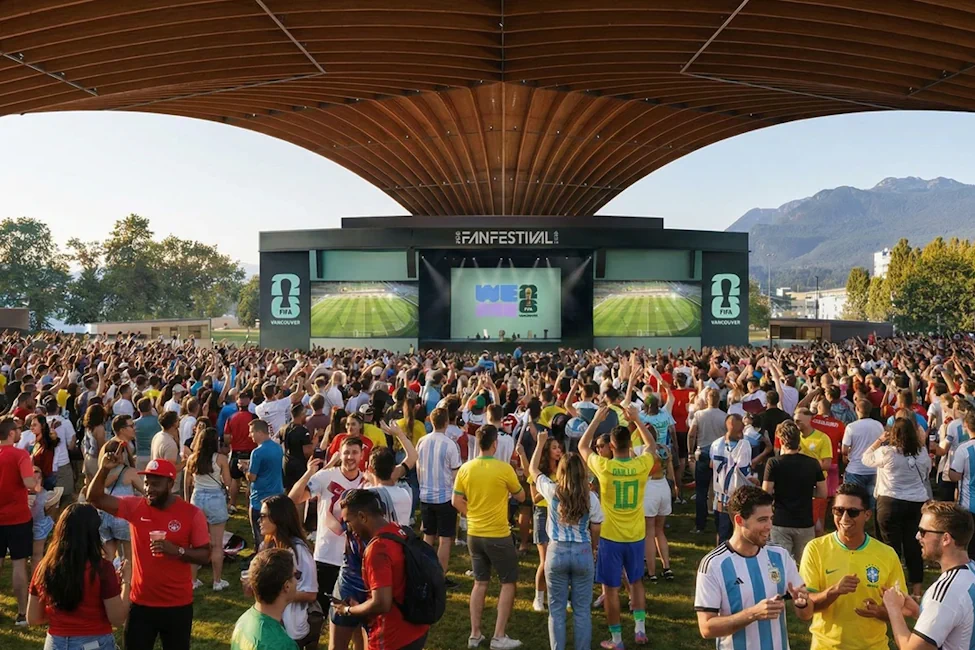
Vancouver hosted seven matches at BC Place, with FIFA reporting a full house of 52,497 for every game. Total stadium attendance reached 367,479. The FIFA Fan Festival Vancouver attracted more than 330,000 attendees between June 11 and June 28, although that was an interim count rather than the final festival total.
The British Columbia government reported major match-day gains for selected downtown businesses. Some restaurants and bars reported sales increases of up to 40 per cent. One Granville Street pub said it exceeded weekly sales targets by more than 50 per cent after the tournament began. Sports apparel retailers reported selling out of Canada jerseys, while some nightlife businesses described record sales.
These are meaningful results, but they are not directly comparable with Toronto’s Moneris data. The Vancouver evidence is based largely on operator reports, industry feedback and examples published by the province, while the Toronto figures cover broader payment categories. Vancouver International Airport also reported nearly 1.8 million passengers during the early tournament period, averaging more than 85,000 travellers per day, and TransLink recorded more than one million customer trips during the first week. Analysts must still determine how much of that activity was additional to a normal Vancouver summer.
Public costs must be compared on the same basis
Toronto’s approved overall hosting budget is $380 million. City documents identify approximately $226.353 million in operating costs and $153.647 million in capital costs across the program. Funding comes from federal and provincial contributions, accommodation-tax revenue, reserves and other city sources. Toronto’s 2026 budget notes state that the operating program will not affect the existing property-tax base.
Vancouver’s accounting is structured differently. The city projected core and essential costs of $320 million to $338 million, plus another $67 million to $74 million for services delivered by other public-sector organizations. It projected offsets of $250 million to $260 million from the Major Events Municipal and Regional District Tax and another $43 million to $53 million from commercial activity, Fan Festival revenue, facility rentals, FIFA-related revenue and the city’s direct contribution.
British Columbia separately projected a maximum net provincial core and essential cost of $114 million after offsetting revenue. Combined local and provincial safety and security costs were estimated at approximately $242 million, with $100 million in additional federal support helping to offset that amount. Some figures are gross costs, others are net after dedicated revenue, and others include separate public organizations. A fair final assessment must compare like with like.
Only two official team base camps were located in Canada
Team base camps matter because longer stays generate spending on accommodation, food, transportation, training operations and support services. FIFA confirmed that only Canada and Panama established their official team base camp training sites in Canada. Seven teams were based in Mexico and the remaining 39 were based in the United States.
Canada operated from the National Soccer Development Centre at the University of British Columbia. Canada Soccer identified the UBC facility as the national team’s official base camp, providing training, recovery, nutrition and sports-science resources. Local reporting identified The Westin Bayshore in downtown Vancouver as the team hotel.
Panama selected the Nottawasaga Resort in New Tecumseth, Ontario. The municipality said the team would stay and prepare there throughout its participation, using a property with accommodations and two training pitches on site. Visiting teams also required temporary match hotels and facilities in Toronto and Vancouver, but those shorter stays were not official group-stage bases. With 46 of 48 official bases outside Canada, much of the longer-duration delegation spending went to American and Mexican communities.
What the World Cup 2026 teaches Canadian entrepreneurs
The early lesson is not simply that major events are good or bad. The gains are concentrated. Businesses closest to fan traffic, international visitors and scheduled match activity were positioned to capture the strongest returns. Operators that adjusted staffing, hours, inventory and promotions around match times had more opportunity than businesses waiting for general citywide demand to arrive.
The foreign-card data in Toronto are especially important. International visitors generated much stronger restaurant and bar growth than the overall market. Multilingual service, mobile-friendly reservations, strong local search visibility and offers designed for short-stay visitors can matter more than broad event branding. There is also a cash-flow risk: higher payroll, extra inventory, security and extended hours can consume the sales gain if margins are not managed carefully.
Canada’s final economic score will take months
The tournament produced measurable winners. Toronto hotels benefited. International visitors spent more in restaurants and bars. Vancouver delivered seven full stadiums and strong match-day results for selected downtown businesses. New Tecumseth gained an official national-team base camp, while both host cities received global exposure and upgraded infrastructure.
What Canada does not yet have is a complete net-impact calculation. Final government expenditures, security costs, hotel occupancy, room rates, international visitor totals, business sales, tax receipts and airport data still need to be consolidated. Analysts must also account for displaced tourism, residents who redirected existing spending and infrastructure that will retain value after the event.
The windfall was real for businesses that captured it. Whether the country’s overall return justifies more than $1 billion in estimated government support remains unanswered. Canada will need several more months of audited costs, tourism statistics and tax data before anyone can credibly call the FIFA World Cup 2026 a financial victory, a draw or an expensive loss.